 By Saurav Mehra
For some motorcycle riders, the exhaust note is part of the bike’s personality. A deeper sound from a Royal Enfield, sports bike or modified street bike may feel more attractive than the factory exhaust. The problem begins when an aftermarket silencer turns that sound into excessive noise—or changes the motorcycle from its legally approved specifications.
Using an aftermarket exhaust on a bike is not automatically illegal in India, but using a loud or modified exhaust that violates prescribed noise, construction, emission or alteration requirements can be illegal. A motorcycle must continue to comply with the Motor Vehicles Act, 1988, the Central Motor Vehicles Rules, 1989 and applicable environmental standards.
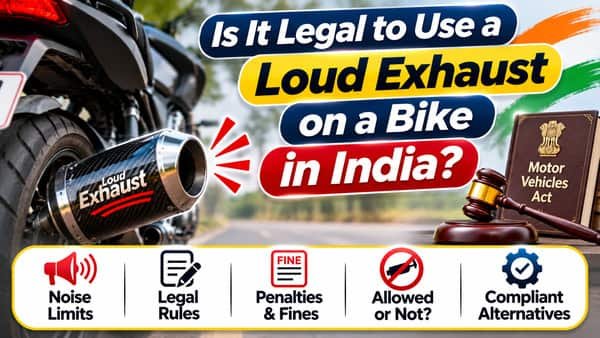
Simply being able to buy a loud exhaust online or from a modification shop does not make it road-legal.
What Does Indian Law Say About Bike Silencers?
Rule 120 of the Central Motor Vehicles Rules, 1989 (CMVR) is particularly important.
It requires every motor vehicle to be fitted with a silencer designed to reduce, as far as practicable, the noise produced by exhaust gases escaping from the engine.
The Rule also requires motor vehicles to be constructed and maintained so that they conform to the applicable noise standards.
This means a motorcycle exhaust is not merely a cosmetic accessory. It forms part of the vehicle’s regulated equipment.
A rider cannot simply remove the silencer or modify it to deliberately produce excessive exhaust noise and assume that the bike remains legally compliant.
Is an Aftermarket Exhaust Completely Illegal?
Not necessarily.
The important question is whether the exhaust and the motorcycle continue to satisfy applicable legal requirements.
An aftermarket exhaust becomes particularly problematic when it:
- Produces excessive noise;
- Removes or defeats the silencing function;
- Affects emission-control equipment;
- Causes the motorcycle to violate applicable standards;
- Constitutes an unauthorised alteration of approved vehicle specifications; or
- Makes the vehicle unsafe for road use.
Therefore, the legal question is not simply whether the exhaust is “stock” or “aftermarket.”
Compliance matters more than the marketing label.
A seller describing an exhaust as “road legal” does not by itself establish compliance with Indian law.
Is There a Legal Decibel Limit for Bike Exhausts?
India does have vehicle noise standards, but riders should be careful with simplified claims such as “anything below 80 dB is legal.”
The applicable limit can depend on the vehicle category, applicable standard, date of manufacture and prescribed testing procedure.
Rule 120 links vehicle compliance to the noise standards specified under the Environment (Protection) Rules, 1986, with testing conducted according to prescribed standards.
Noise is therefore not determined merely by downloading a smartphone decibel-meter app and holding the phone next to the exhaust.
Official testing conditions and procedures matter.
The safest practical standard for an ordinary rider is to keep the motorcycle’s exhaust system compliant with its approved specifications rather than trying to stay just below a number found on social media.
Can You Remove the DB Killer?
A DB killer or baffle is commonly fitted inside certain exhaust systems to reduce sound.
Removing it specifically to make the motorcycle significantly louder can create a legal problem if the resulting exhaust noise no longer complies with the prescribed standards.
It may also undermine the silencing function required under Rule 120.
A common situation is a rider purchasing an aftermarket exhaust that sounds moderate with the baffle installed but becomes dramatically louder when it is removed.
The fact that the exhaust was originally sold with a noise-reducing component does not make its deliberately louder configuration automatically legal.
Can Police Issue a Challan for a Loud Silencer?
Yes, enforcement action can be taken when a motorcycle does not comply with applicable motor-vehicle requirements.
The Motor Vehicles Act contains provisions concerning the construction, maintenance, alteration and unsafe use of motor vehicles. Depending on the circumstances, authorities may proceed under the provision applicable to the particular violation.
A loud exhaust can also attract attention to other modifications on the motorcycle.
During an inspection, authorities may notice:
- Removed mirrors;
- Illegal number plates;
- Non-compliant lighting;
- Structural modifications;
- Emission-related changes; or
- Other unsafe equipment.
Therefore, the legal consequences are not necessarily limited to exhaust noise alone.
What About a Modified Silencer on a Royal Enfield?
Royal Enfield motorcycles are frequently associated with aftermarket silencers, but there is no separate general exemption merely because a particular motorcycle is known for its exhaust sound.
The same regulatory principles apply.
A replacement exhaust that creates excessive noise or causes the vehicle to cease complying with applicable standards can lead to action.
Terms such as:
- “Bullet silencer,”
- “free-flow exhaust,”
- “performance exhaust,”
- “short bottle,” or
- “sports exhaust”
do not determine legality.
The actual configuration and compliance of the motorcycle matter.
Can You Modify the Exhaust for Better Performance?
Performance modifications require additional caution.
Some exhaust systems alter exhaust flow to improve performance. But a modification cannot be treated as lawful merely because it increases horsepower.
Changes can affect:
- Noise output;
- Exhaust emissions;
- Catalytic converter operation;
- Engine tuning;
- Fuel consumption; and
- The vehicle’s approved specifications.
Section 52 of the Motor Vehicles Act also restricts alterations that cause the particulars of a registered vehicle to differ from those originally specified by the manufacturer, subject to the exceptions provided by law.
Major exhaust or engine-related modifications therefore need to be considered in the broader vehicle-compliance framework.
Is Removing the Catalytic Converter Legal?
A rider should not remove or bypass emission-control equipment merely to increase exhaust sound or performance.
Motorcycles must comply with applicable emission standards, and the exhaust system can form an important part of that compliance.
A modified exhaust that interferes with the catalytic converter or other pollution-control equipment can create an emission problem in addition to the noise issue.
A bike having a valid Pollution Under Control (PUC) certificate should also not be treated as proof that every physical modification made to the motorcycle is lawful.
Noise compliance and emission compliance are related but separate requirements.
Can You Use a Loud Exhaust on Private Property?
Using a motorcycle exclusively on genuinely private premises can raise different issues from operating it on a public road, but private property is not necessarily a legal free-for-all.
Excessive noise can still potentially create problems under environmental, nuisance or local noise-control requirements depending on the circumstances.
More importantly, a motorcycle modified for closed-track use should not automatically be assumed to be lawful for ordinary public-road use.
“Track use” and “road legal” are different concepts.
Can a Mechanic Legally Install Any Exhaust You Ask For?
Do not assume so.
Vehicle owners and modification shops both operate within a regulated system. The Motor Vehicles Act contains provisions dealing with the construction, maintenance, sale and alteration of vehicles and components.
A mechanic’s willingness to install a component is therefore not proof of legality.
Before installing an aftermarket exhaust, ask:
- Is it designed for your exact motorcycle?
- Does it retain required emission equipment?
- Does it comply with applicable noise requirements?
- Does it require alteration of other vehicle components?
- Is it approved or certified for road use in the relevant configuration?
If the shop’s main selling point is that the exhaust is “extremely loud,” that should itself be a warning sign for a road-going motorcycle.
How Can You Keep a Modified Bike Road-Legal?
If you want to change your motorcycle’s exhaust while reducing legal risk:
- Prefer the manufacturer’s approved exhaust system.
- Avoid exhausts designed primarily to create excessive noise.
- Do not remove noise-reduction components merely to make the bike louder.
- Do not remove or bypass catalytic converters or emission equipment.
- Ensure the motorcycle continues to meet applicable emission standards.
- Avoid modifications inconsistent with the vehicle’s approved specifications.
- Keep invoices and certification documents for legitimate replacement components.
- Maintain the silencer properly and repair exhaust leaks.
A pleasant exhaust note and an illegally loud exhaust are not the same thing. Indian law requires the motorcycle to remain within applicable noise and vehicle standards, regardless of how popular a particular modification may be among riders.
FAQs
Q1. Is an aftermarket silencer legal on a bike in India?
A. An aftermarket exhaust is not automatically illegal merely because it is aftermarket. However, it must not cause the motorcycle to violate applicable noise, emission, construction or alteration requirements.
Q2. Can police fine me if my bike’s exhaust is too loud?
A. Yes. A motorcycle that violates applicable noise or vehicle standards can attract enforcement action under the Motor Vehicles Act and relevant rules.
Q3. Is removing the DB killer from an exhaust legal?
A. Removing a DB killer can become problematic if it causes the motorcycle to exceed applicable noise standards or defeats the exhaust’s required silencing function. It should not be assumed to be road-legal.
Q4. Is a loud exhaust legal if my bike has a valid PUC certificate?
A. Not necessarily. A PUC certificate primarily concerns prescribed pollution/emission testing. It does not automatically establish that an excessively loud or otherwise non-compliant exhaust system is lawful.