 By Saurav Mehra
Speed matters when cryptocurrency is being used for payments rather than simply held as an investment. Waiting several minutes—or longer—for a transaction to become sufficiently confirmed may be acceptable when moving long-term holdings, but it is far less convenient when paying a merchant, transferring money to another person or making a small everyday payment.
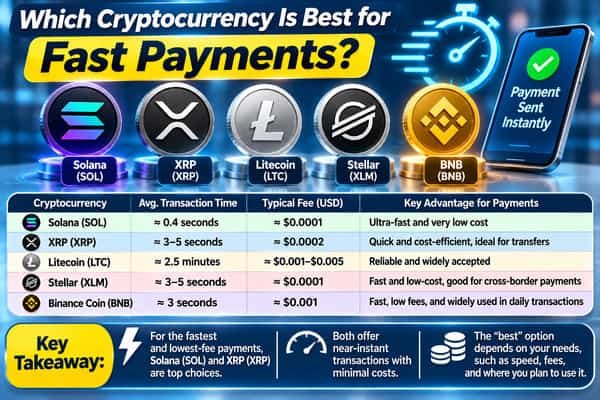
Several cryptocurrency networks are specifically designed for fast transfers. Nano (XNO), XRP, Stellar (XLM) and Solana (SOL) are among the notable options, although they achieve speed in different ways. Nano focuses heavily on direct feeless payments, XRP Ledger and Stellar are designed around rapid value transfer, while Solana combines fast payments with a broader smart-contract ecosystem.
The best option therefore depends on more than raw speed. Transaction fees, finality, liquidity, wallet support and whether the recipient supports the network are equally important.
Nano (XNO): Built for Fast, Feeless Payments
Nano is one of the most payment-focused cryptocurrencies.
Instead of using a traditional blockchain where all transactions compete to enter the same blocks, Nano uses a block-lattice architecture, where individual accounts maintain their own chains.
Its Open Representative Voting consensus mechanism is used to resolve conflicts and confirm transactions.
Under typical network conditions, Nano documentation reports average confirmation times of around 0.2 seconds, while transactions are feeless at the protocol level.
This combination makes Nano particularly interesting for:
- Person-to-person transfers
- Small payments
- Merchant payments
- Micropayments
- Frequent transactions
If someone sends a small amount of XNO, a conventional network transaction fee does not consume part of the payment.
However, speed and zero fees do not automatically make XNO the best cryptocurrency for every user. Exchange availability, liquidity, merchant acceptance and broader adoption also matter.
XRP: Designed for Rapid Value Transfer
XRP operates on the XRP Ledger, which is designed for efficient value transfers.
Unlike Bitcoin, XRP Ledger does not depend on Proof-of-Work mining.
Instead, network participants use a consensus process to agree on the state of the ledger.
The XRP Ledger can generally reach settlement within a few seconds, making it considerably faster for ordinary payments than waiting for multiple Bitcoin confirmations.
XRP transactions also normally have very small network costs.
These characteristics make XRP relevant for:
- Cross-border transfers
- Person-to-person payments
- Rapid settlement
- Moving funds between supported platforms
Another advantage is liquidity. XRP is widely traded across the cryptocurrency market, making it easier to buy or sell than many smaller payment-focused cryptocurrencies.
Stellar (XLM): Strong Option for Cross-Border Payments
Stellar is another blockchain built with payments and asset transfers as major use cases.
The network uses the Stellar Consensus Protocol rather than cryptocurrency mining.
Stellar generally reaches consensus in under six seconds, with ledger entries becoming final once consensus is achieved.
The network also charges extremely small transaction fees.
This combination makes Stellar particularly relevant for:
- International transfers
- Remittances
- Digital payments
- Stablecoin transfers
- Tokenized assets
- Small-value transactions
Stellar can transfer more than just its native XLM cryptocurrency. The network supports other issued digital assets, which can be useful when users want fast blockchain settlement without necessarily taking exposure to the price volatility of XLM itself.
Solana (SOL): Fast Payments With a Larger Blockchain Ecosystem
Solana takes a broader approach.
Rather than focusing almost entirely on payments, it is a programmable blockchain supporting smart contracts and decentralized applications.
Its infrastructure is used for:
- Cryptocurrency payments
- Stablecoin transfers
- DeFi
- Token trading
- NFTs
- Blockchain applications
- Merchant payment systems
Solana specifically highlights fast confirmation times, sub-cent fees and stablecoin functionality as features designed for payments.
This can make Solana particularly useful when someone wants fast payments while also accessing a broader smart-contract ecosystem.
However, a simple SOL transfer and a complicated smart-contract transaction are not identical. More complex blockchain activity can involve additional computational resources and costs.
Why Is Bitcoin Slower for Everyday On-Chain Payments?
Bitcoin prioritizes a different set of design characteristics.
Its Proof-of-Work blockchain targets an average block interval of approximately 10 minutes.
Receiving one Bitcoin confirmation may therefore take several minutes, while recipients requiring multiple confirmations may wait considerably longer.
Bitcoin’s base layer emphasizes characteristics such as:
- Decentralization
- Security
- Predictable monetary rules
- Settlement of high-value transactions
That does not mean Bitcoin cannot be used for fast payments.
The Lightning Network allows Bitcoin payments to occur through payment channels rather than requiring every individual payment to wait for a new Bitcoin block.
Lightning can make Bitcoin substantially faster and cheaper for smaller payments, although it introduces a different payment architecture from ordinary on-chain Bitcoin transactions.
Why Transaction Finality Matters More Than Advertised Speed
When comparing fast cryptocurrencies, it is easy to focus only on transactions per second or block production speed.
But payment speed should also consider finality.
Suppose Blockchain A displays your transaction after one second but requires additional time before the payment can be considered reliably settled.
Blockchain B takes four seconds but provides strong finality immediately after consensus.
For a merchant, Blockchain B could actually provide the more useful payment experience.
A good payment network should therefore be evaluated based on:
- Time until transaction inclusion
- Time until confirmation
- Time until finality
- Risk of transaction reversal
- Reliability during heavy network usage
Raw TPS figures alone do not provide the complete picture.
Fast Payments Also Need Low Transaction Fees
Speed becomes much less useful if each payment costs a significant amount.
Imagine paying ₹100 for coffee but spending another ₹50 in blockchain fees.
The payment system would be impractical for everyday purchases.
Payment-focused cryptocurrencies therefore usually attempt to combine:
Fast confirmation + low fees
Nano takes this further with feeless protocol-level transactions, while XRP Ledger, Stellar and Solana generally process ordinary transactions for very small network costs.
For high-frequency or low-value payments, even small differences in transaction fees can become important.
Stablecoins Can Be Better for Payments Than Volatile Cryptocurrencies
Transaction speed is not the only challenge with cryptocurrency payments.
Price volatility matters too.
Suppose someone receives ₹10,000 worth of a cryptocurrency today. If the asset falls 8% tomorrow, the recipient effectively experiences a substantial change in value.
Stablecoins attempt to reduce this problem by tracking another asset, usually the US dollar.
Fast blockchain networks can therefore be useful not only for transferring their native cryptocurrencies but also for transferring supported stablecoins.
Solana and Stellar, for example, support digital assets that can be used for payment applications.
For practical payments, the combination of a fast blockchain and an appropriately structured stable asset can sometimes be more useful than paying directly with a volatile native cryptocurrency.
Which Cryptocurrency Is Best for International Payments?
International payments involve more than blockchain transaction speed.
Users also need to consider how easily money can enter and leave the crypto ecosystem.
A cryptocurrency might settle in seconds, but if converting it back into local currency takes hours or involves expensive fees, the overall payment experience is not necessarily fast.
For cross-border transfers, consider:
- Blockchain settlement speed
- Transaction fees
- Exchange liquidity
- Availability in both countries
- Local currency conversion
- Withdrawal costs
- Regulatory requirements
XRP and Stellar are particularly associated with fast value-transfer use cases, while other networks can also support international crypto and stablecoin payments.
Which Is Faster: XRP or Stellar?
Both networks provide settlement within seconds under normal conditions.
XRP Ledger documentation describes near-real-time settlement in roughly three to six seconds, while Stellar states that its consensus process completes in under six seconds.
For an ordinary user, the practical difference between a few seconds on either network is often less important than:
- Exchange support
- Fees
- Liquidity
- Receiving-wallet compatibility
- Asset being transferred
Choosing between two networks solely because one may be a few seconds faster can overlook more important practical factors.
Which Is Faster: Nano or Bitcoin?
For ordinary native on-chain transactions, Nano is significantly faster.
Nano’s documentation reports split-second confirmation under typical network conditions and protocol-level feeless transactions.
Bitcoin’s base layer targets approximately 10 minutes between blocks on average.
However, comparing Nano with Bitcoin Lightning produces a different discussion because Lightning payments do not wait for normal Bitcoin on-chain block confirmation for every individual payment.
Bitcoin also has far greater market liquidity and broader recognition.
Speed is therefore only one dimension of a payment network.
What Should You Check Before Choosing a Crypto for Payments?
Before selecting a cryptocurrency simply because it is fast, check whether it works for your actual payment situation.
Consider:
- Transaction confirmation time
- Settlement finality
- Network fees
- Exchange withdrawal charges
- Wallet availability
- Merchant acceptance
- Liquidity
- Stablecoin support
- Network reliability
- Conversion into local currency
Most importantly, confirm that the recipient supports the exact cryptocurrency and blockchain network you intend to use.
Sending money quickly is useless if it arrives through a network the recipient cannot access.
Which Cryptocurrency Is Best Overall for Fast Payments?
There is no universal winner.
Nano (XNO) stands out for extremely fast, feeless native transfers and a design specifically focused on digital payments.
XRP combines settlement within seconds with substantial market liquidity and a network built around value transfer.
Stellar (XLM) combines rapid finality, very low fees and strong functionality for payments and digital assets.
Solana (SOL) provides fast, inexpensive transactions while supporting a much broader smart-contract and stablecoin ecosystem.
For pure person-to-person native cryptocurrency payments, Nano’s speed and feeless design are particularly notable. For cross-border value transfer, XRP and Stellar deserve consideration. For payments integrated with stablecoins and blockchain applications, Solana can offer greater flexibility.
The best payment cryptocurrency is therefore not simply the one capable of producing the highest transaction-speed number. It is the network that can deliver fast finality, low costs, sufficient liquidity and convenient access for both the sender and recipient.
FAQs
Q1. Which cryptocurrency confirms payments the fastest?
A. Nano is among the fastest payment-focused cryptocurrencies, with its documentation reporting average confirmation around 0.2 seconds under typical conditions. XRP Ledger and Stellar generally settle transactions within a few seconds, while Solana also offers fast confirmations.
Q2. Is XRP good for fast payments?
A. Yes. XRP Ledger is designed for rapid value transfer and generally reaches settlement within a few seconds. Transaction costs are also typically very small, making XRP suitable for payment-focused use cases.
Q3. Is Bitcoin too slow for everyday payments?
A. Bitcoin’s base-layer transactions can be relatively slow for point-of-sale payments because blocks arrive approximately every 10 minutes on average. However, the Lightning Network provides an alternative designed for faster, lower-cost Bitcoin payments.
Q4. Is the fastest cryptocurrency always the best for payments?
A. No. Speed is only one factor. A useful payment cryptocurrency also needs low fees, reliable finality, sufficient liquidity, wallet and exchange support, network reliability and convenient conversion into the currency the recipient ultimately wants.