 By Saurav Mehra
City traffic is normally bad news for fuel economy. Every slowdown wastes momentum, frequent acceleration burns more fuel, and long periods of idling achieve zero kilometres per litre. A strong-hybrid car changes that equation: it can recover energy while slowing down, shut the petrol engine off more frequently and use an electric motor during situations where a conventional engine is relatively inefficient.
That makes hybrids particularly relevant in India for drivers who want lower fuel consumption but are not ready to depend on charging infrastructure.
Not all hybrids work the same way, however. A strong hybrid can drive using the electric motor alone under suitable conditions, while a mild hybrid mainly assists the petrol engine. For buyers primarily interested in maximum mileage, strong hybrids deserve priority.
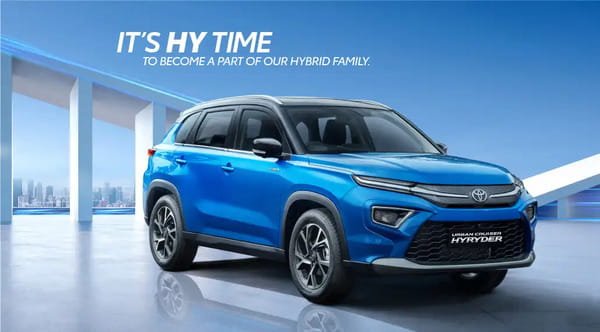
Here are 10 hybrid cars worth considering in India.
1. Toyota Urban Cruiser Hyryder Hybrid
The Hyryder is one of the clearest examples of why strong-hybrid technology works well for Indian conditions.
Its 1.5-litre self-charging strong-hybrid system uses an electric motor alongside the petrol engine and an e-drive transmission. Toyota currently quotes certified fuel efficiency of 27.97 km/l.
Toyota says the strong-hybrid version can operate with the engine switched off for up to 40% of distance and 60% of running time under applicable conditions.
That ability makes the Hyryder particularly efficient in urban traffic, where frequent slowing and low-speed operation give the hybrid system more opportunities to recover and reuse energy.
Best for: Buyers wanting maximum mileage from a midsize SUV.
2. Maruti Suzuki Grand Vitara Strong Hybrid
The Grand Vitara shares the basic strong-hybrid philosophy of the Hyryder and matches its impressive 27.97 km/l certified efficiency.
Its system combines a 1.5-litre petrol engine, electric motor, lithium-ion battery and e-CVT. It can operate in electric-only mode under suitable conditions and uses regenerative braking to recover energy.
The Grand Vitara also provides features such as ventilated seats, a 360-degree camera and panoramic sunroof on applicable versions, making the hybrid powertrain available without sacrificing the equipment expected from a modern family SUV.
Best for: Families wanting strong-hybrid efficiency with Maruti’s ownership ecosystem.
3. Honda City e
The City e takes hybrid efficiency into a sedan rather than an SUV.
Its strong-hybrid system is particularly interesting because the electric motor plays a major role in propulsion. At lower speeds and in suitable situations, the system can operate without constantly relying on the petrol engine.
The aerodynamic sedan body also complements the efficient powertrain, making the City e especially attractive to people who cover substantial distances but do not need SUV ground clearance or styling.
The biggest consideration is purchase price. Buyers should calculate how many kilometres they drive annually before assuming the fuel savings will automatically recover the hybrid’s additional initial cost.
Best for: High-mileage users wanting an efficient and comfortable sedan.
4. Maruti Suzuki Victoris Strong Hybrid
The Victoris expands Maruti Suzuki’s strong-hybrid strategy beyond the Grand Vitara.
For fuel-conscious buyers, its main attraction is the ability to combine SUV practicality with electric assistance without requiring external charging.
As with other strong hybrids, the greatest advantage is likely to appear in stop-start urban conditions. Regenerative braking can recover some energy while slowing, and the electric motor can reduce the amount of time the petrol engine needs to operate.
This makes the Victoris worth considering for buyers who like the idea of an electrified vehicle but cannot conveniently install an EV charger at home.
Best for: Urban SUV users wanting hybrid efficiency without plugging in.
5. Toyota Innova Hycross Hybrid
Fuel efficiency becomes even more impressive when the vehicle in question is a large three-row family MPV.
The Innova Hycross combines a 2.0-litre petrol engine with Toyota’s strong-hybrid technology. Its efficiency is substantially better than many buyers would expect from a vehicle capable of carrying a large family.
The system is particularly well suited to families whose Hycross spends considerable time in urban traffic. Instead of keeping a relatively large petrol engine running continuously, the hybrid system can use electric assistance and regenerative braking.
For highway-heavy users, the efficiency advantage remains useful, although strong hybrids generally demonstrate their biggest advantage in mixed and urban conditions.
Best for: Large families wanting space without conventional big-petrol fuel consumption.
6. Maruti Suzuki Invicto
The Invicto provides Maruti Suzuki buyers with a premium three-row strong-hybrid option.
Maruti currently quotes 22.16 km/l for its strong-hybrid system.
That figure is particularly noteworthy given the Invicto’s size and passenger capacity. A conventional large petrol MPV would normally require considerably more fuel in urban conditions.
The Invicto therefore makes sense for large families that regularly cover significant kilometres but still want a spacious, automatic vehicle.
Its self-charging design also means there is no need to plug the vehicle into an external charger.
Best for: Large families wanting an efficient premium MPV.
7. Toyota Camry Hybrid
The Camry demonstrates that hybrid technology can be used for refinement as effectively as it is used for economy.
Its petrol-electric system allows quiet low-speed operation and smooth power delivery, characteristics that suit a premium sedan particularly well.
The Camry is considerably more expensive than mainstream hybrids such as the Hyryder and Grand Vitara, so buyers are unlikely to choose it solely to save money at the fuel station.
Instead, its attraction lies in combining improved fuel efficiency with a quiet, comfortable and premium driving experience.
For owners who are frequently chauffeur-driven, the smoothness of the hybrid powertrain can be as valuable as its mileage.
Best for: Premium-sedan buyers wanting refinement and hybrid efficiency.
8. Toyota Vellfire
At first glance, fuel economy may seem an unusual reason to discuss a large luxury MPV such as the Vellfire.
But hybridisation makes particular sense in a heavy vehicle that would otherwise depend entirely on a petrol engine. Electric assistance can reduce fuel use during low-speed operation, while regenerative braking recovers energy that a conventional braking system would largely dissipate as heat.
The Vellfire is obviously not an economical purchase in absolute terms. Its hybrid system is about making a large luxury vehicle more efficient than an equivalent conventional petrol arrangement, rather than competing with a Hyryder for kilometres per litre.
Best for: Luxury buyers wanting an electrified chauffeur-driven MPV.
9. Maruti Suzuki Ertiga Smart Hybrid
The Ertiga illustrates the difference between strong- and mild-hybrid technology.
Its Smart Hybrid system provides functions such as idle start-stop and energy recuperation rather than allowing meaningful electric-only driving like a strong hybrid.
The benefit is a simpler and more affordable approach.
For families needing seven seats, the Ertiga remains an economical vehicle to run, particularly compared with larger SUVs. Buyers covering very high annual distances can also evaluate the factory-CNG version, which may deliver lower fuel cost than the petrol mild hybrid depending on local fuel prices.
Best for: Budget-conscious families needing seven seats.
10. Maruti Suzuki Brezza Smart Hybrid
The Brezza brings mild-hybrid assistance to a compact-SUV format on applicable powertrain configurations.
Its approach is less sophisticated than the strong-hybrid system used in the Grand Vitara. Instead of regularly propelling the vehicle using electric power alone, the system primarily supports the petrol engine and improves efficiency through technologies such as energy regeneration and automatic start-stop.
The advantage is that buyers get a familiar petrol-SUV ownership experience without paying the larger premium associated with a full strong-hybrid powertrain.
Best for: Compact-SUV buyers wanting sensible petrol efficiency.
Strong Hybrid vs Mild Hybrid: Which Saves More Fuel?
This distinction should influence your buying decision more than the word “hybrid” on the brochure.
A mild-hybrid system generally uses a small electrical system to assist the combustion engine. It may provide:
- Automatic engine start-stop
- Brake-energy regeneration
- Limited torque assistance
- Reduced engine load in certain situations
A strong hybrid uses a much more capable electric motor and battery. It can typically:
- Move using electric power alone in suitable situations
- Shut the petrol engine off more frequently
- Recover energy through regenerative braking
- Automatically combine petrol and electric propulsion
- Reduce fuel consumption substantially in urban traffic
The difference is visible in official figures. Maruti Suzuki quotes 27.97 km/l for the strong-hybrid Grand Vitara, whereas its non-strong-hybrid powertrain has historically been rated at up to 21.11 km/l depending on configuration.
For maximum petrol savings, the strong hybrid is therefore the more relevant technology.
Why Strong Hybrids Can Be Excellent in City Traffic
With conventional petrol cars, highway cruising often produces better mileage than city driving.
Strong hybrids can narrow that gap.
When the vehicle slows, regenerative braking converts some kinetic energy into electricity and stores it in the hybrid battery. That energy can later help propel the car.
At low speeds, the vehicle may also operate temporarily using its electric motor with the engine switched off. Toyota says the Hyryder strong hybrid can run with the engine off for significant portions of applicable city operation.
This explains why buyers who spend substantial time in stop-start traffic can benefit more from strong-hybrid technology than someone whose driving consists almost entirely of uninterrupted highways.
Do Hybrid Cars Need External Charging?
Self-charging hybrids such as the Hyryder, Grand Vitara, City e and Innova Hycross do not need to be plugged into a charger.
Their batteries receive energy from the engine and regenerative braking.
This gives them an important practical advantage for people living in apartments or locations where installing a home EV charger is difficult.
You simply refuel with petrol as you would with a conventional car.
Does the Higher Hybrid Price Make Financial Sense?
This depends heavily on how much you drive.
Suppose a conventional petrol SUV returns 15 km/l in your usage and its strong-hybrid alternative manages 22 km/l. Over only 5,000 km per year, the annual saving may not justify a large purchase-price difference quickly.
At 15,000–20,000 km per year, the calculation becomes much more interesting.
Before purchasing, compare:
Hybrid price premium ÷ estimated annual fuel saving = approximate payback period
But financial payback is not the only advantage. Strong hybrids also provide quiet low-speed driving, automatic transmission convenience and reduced engine operation in congested conditions.
Toyota currently backs the Hyryder’s hybrid battery with an 8-year/160,000 km warranty, which is also worth considering when evaluating long-term ownership.
FAQs
Q1. Which hybrid car gives the best mileage in India?
A. Among mainstream strong-hybrid SUVs, the Toyota Urban Cruiser Hyryder and Maruti Suzuki Grand Vitara are both officially rated at 27.97 km/l.
Q2. Do strong-hybrid cars need to be charged at home?
A. No. Self-charging strong hybrids do not need external charging. Their batteries are recharged through the internal combustion engine and regenerative braking. This makes them different from plug-in hybrids and battery-electric vehicles.
Q3. Is a strong hybrid better than CNG for saving money?
A. Not necessarily. CNG can offer a lower fuel cost per kilometre, especially for high-mileage users. Strong hybrids provide other advantages, such as automatic operation, no need for CNG refuelling, and fewer compromises in everyday usability. Compare local petrol and CNG prices along with your annual mileage before choosing.
Q4. Is a hybrid worth buying for mostly highway driving?
A. Yes, a strong hybrid can still be efficient on highways, but its advantage over an efficient conventional petrol car may be smaller than in city driving. Strong hybrids benefit significantly from regenerative braking and electric-only operation, which occur more frequently in mixed and stop-start traffic.