 By Saurav Mehra
Indian summers make tinted car windows tempting. They can reduce glare, improve cabin comfort and give passengers more privacy. That often leads to a practical question: if the glass is still reasonably transparent, can you simply install a light sun-control film and remain within the law?
The answer is more restrictive than many car owners expect. Factory-manufactured tinted safety glass meeting the prescribed Visible Light Transmission (VLT) standards is permitted in India. However, the Supreme Court has prohibited pasting black film or other additional material on the safety glass of vehicles.
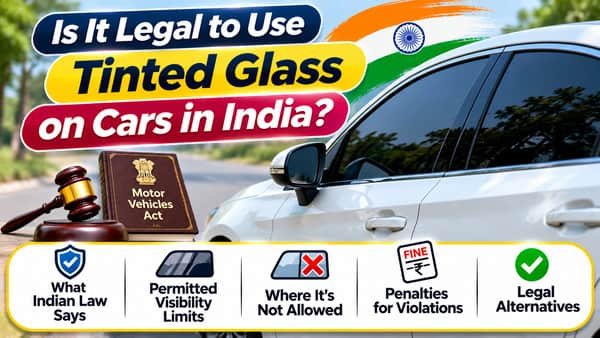
This distinction between factory-fitted tinted glass and aftermarket tinting film is essential.
What Are the Legal VLT Limits in India?
Rule 100 of the Central Motor Vehicles Rules, 1989 regulates safety glass used in motor vehicles.
The prescribed minimum Visible Light Transmission is:
- Front windscreen – at least 70% VLT
- Rear window – at least 70% VLT
- Side windows – at least 50% VLT
VLT tells you how much visible light can pass through the glass.
For example, 70% VLT means at least 70% of visible light passes through. A lower VLT generally means darker glass.
However, these percentages should not be interpreted as permission to paste an aftermarket film until the final combination reaches 70% or 50%.
That argument was specifically rejected by the Supreme Court.
Are Tinted Windows Completely Banned?
No.
This is one of the most common misconceptions about tinted glass in India.
The law does not require every car window to be perfectly colourless. A manufacturer can provide appropriately tinted safety glass as long as it conforms to the prescribed standards.
The Supreme Court clarified that tinted safety glass manufactured with the required VLT is different from film subsequently pasted onto the glass.
Therefore, a car with legally compliant factory-fitted tinted glass is not automatically illegal merely because its windows have some tint.
The problem arises when additional film or material is applied over the safety glass.
Is Aftermarket Sun Film Legal if It Meets the VLT Limit?
This is where many car owners make a mistake.
Suppose your car’s side window allows 80% light transmission. A shop offers a light sun-control film and claims that, even after installation, the total VLT will remain above 50%.
You might think the installation is therefore legal.
The Supreme Court rejected this interpretation in Avishek Goenka v. Union of India.
The Court held that the VLT requirements apply to the safety glass manufactured according to the prescribed specifications. It prohibited black film or other material being pasted on the windscreen and windows.
Therefore, an aftermarket seller’s claim that a film is “50% VLT legal” or “RTO approved” should not automatically be accepted as proof that it is lawful for use on your car.
Why Did the Supreme Court Ban Black Films?
In its 2012 decision, the Supreme Court considered both vehicle-safety requirements and concerns about the misuse of heavily covered vehicles for criminal activity.
The Court ultimately directed enforcement authorities to prohibit black films or other materials pasted onto vehicle safety glass.
It also directed competent traffic authorities to challan offending vehicles and remove prohibited films.
The important point for an ordinary vehicle owner is that the judgment was not limited only to completely black or opaque film.
The Court subsequently clarified that additional film cannot become permissible merely because someone claims that the final VLT remains within the percentages specified under Rule 100.
Can a Car Have Factory-Fitted Privacy Glass?
Factory-fitted tinted glass can be lawful if it complies with the applicable standards.
Some vehicles are manufactured with glass that naturally has a darker appearance or provides solar protection without requiring a separate film to be pasted later.
The crucial distinction is that the glass itself must be manufactured and approved according to applicable standards while maintaining the required light transmission.
This is different from buying a normal car and later asking an accessory shop to paste a dark sheet over its windows.
If your vehicle came from the manufacturer with tinted glass, do not automatically remove it merely because it looks darker than completely clear glass. Verify whether it is manufacturer-fitted compliant safety glass.
What About Transparent UV or Heat-Rejection Films?
This is another area where marketing claims can be misleading.
Accessory shops may advertise films as:
- Clear UV protection film;
- Heat-control film;
- Ceramic tint;
- Transparent solar film;
- IR rejection film; or
- Legal sun film.
A product’s transparency does not by itself determine whether pasting it on vehicle safety glass is permissible.
The Supreme Court’s direction referred not merely to extremely dark film but to black film or any other material pasted on vehicle safety glass.
Therefore, you should not assume that an aftermarket film becomes legal simply because it is transparent or marketed primarily for heat reduction rather than privacy.
Can You Use Curtains or Sunshades Instead?
Car owners sometimes attempt to avoid tint restrictions by using curtains, magnetic shades or removable screens.
These accessories should not be used in a way that obstructs the driver’s visibility or defeats road-safety requirements.
An accessory that significantly blocks the driver’s view through windows or mirrors can create a separate safety and enforcement issue.
Temporary sun protection used while a vehicle is parked is a different practical situation from driving on public roads with the driver’s visibility obstructed.
For children or passengers requiring sun protection, consider manufacturer-approved solutions that do not interfere with visibility or violate applicable vehicle requirements.
Are There Medical Exemptions for Tinted Film?
Drivers sometimes argue that they need dark films because of a medical condition involving sensitivity to sunlight.
The Supreme Court considered requests concerning exceptions and did not create a broad personal medical exemption allowing individuals to paste films on vehicle windows.
Therefore, a doctor’s prescription by itself should not be treated as automatic legal permission to install black film.
Where a person has a serious medical requirement, they should seek guidance through the competent government or transport authority rather than relying on an accessory shop’s interpretation of the law.
Are VIP and Security Vehicles Exempt?
There is no general rule allowing someone to use black films merely because they are a politician, government official, celebrity or other prominent person.
In its judgment, the Supreme Court discussed exceptional security situations and indicated that cases involving persons provided specified high-level security could be considered by the competent authorities in accordance with law.
This is very different from an ordinary individual deciding that tinted windows are necessary for personal security.
Any genuine exemption must come through the appropriate legal and governmental mechanism.
Can Traffic Police Remove Tinted Film?
Yes.
The Supreme Court specifically directed competent traffic police and other authorised persons to take enforcement action against vehicles violating the applicable rules and to remove prohibited black films.
Current traffic-police guidance also continues to treat extra black film/tinting as prohibited.
Therefore, paying a challan does not necessarily mean you can leave the illegal film installed and continue driving.
The non-compliant material itself may have to be removed.
Does the Rule Apply Across India?
Yes. The Supreme Court’s prohibition was issued for vehicles throughout the country.
This means an aftermarket tint should not be assumed legal merely because enforcement appears less strict in a particular city or State.
Enforcement intensity can vary, but the underlying nationwide legal position does not depend on whether traffic police in your area routinely check tinted windows.
Similarly, crossing from one State into another does not convert prohibited film into lawful tint.
What Should You Do Before Tinting Your Car?
If reducing heat inside the cabin is your main concern:
- Check whether your vehicle already has manufacturer-fitted solar-control or tinted safety glass.
- Do not assume an aftermarket film is legal because the seller calls it “RTO approved.”
- Do not rely only on a VLT meter reading to justify pasted film.
- Avoid black, reflective or privacy films on safety glass.
- Keep the windscreen and windows compliant with Rule 100.
- Consider manufacturer-approved heat-management options that comply with the applicable standards.
- Avoid accessories that interfere with the driver’s visibility.
The legal distinction is straightforward: compliant tinted safety glass manufactured as part of the vehicle’s approved glazing system can be permitted; adding aftermarket film over the safety glass is a different matter and is prohibited under the Supreme Court’s directions.
FAQs
Q1. Is 50% tinted film legal on car windows in India?
A. Do not confuse the 50% VLT requirement for side-window safety glass with permission to install a 50% aftermarket film. The Supreme Court has held that the prescribed VLT relates to compliant safety glass and has prohibited additional films or material pasted onto it.
Q2. Is factory-fitted tinted glass legal in India?
A. Yes, factory-manufactured tinted safety glass can be legal if it satisfies the prescribed standards. The windscreen and rear window must provide at least 70% VLT, while side-window glass must provide at least 50% VLT.
Q3. Is transparent sun-control film legal?
A. Do not assume that a film is permissible merely because it is transparent, ceramic, UV-blocking or heat-rejecting. The Supreme Court’s ruling prohibits additional film or other material pasted on vehicle safety glass.
Q4. Can I use dark tinted windows because of India’s hot weather?
A. Hot weather by itself does not create an exemption from the vehicle-glazing requirements. Consider compliant manufacturer-provided glazing and other lawful heat-management methods instead of prohibited aftermarket films.