 By Saurav Mehra
Social media posts can disappear quickly. A controversial Instagram Story may vanish after 24 hours, a defamatory Facebook post can be deleted after receiving a legal notice, or an abusive comment may disappear as soon as the account owner realises it could become evidence. Taking a screenshot is often the easiest way to preserve what appeared on the screen.
But does pressing the screenshot button violate Indian law?
Generally, merely taking a screenshot of a social media post that you can lawfully view is not automatically illegal in India. The more complicated legal questions usually arise from how you obtained access to the content and what you subsequently do with the screenshot.
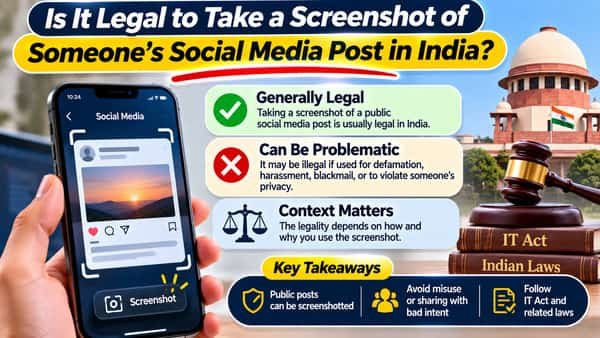
Saving a screenshot for your records is very different from republishing someone’s photograph, private information or copyrighted content to thousands of people.
Is Taking a Screenshot of a Public Post Illegal?
There is no general Indian law that makes the ordinary act of taking a screenshot of a publicly accessible social-media post an offence by itself.
For example, someone might screenshot:
- A Facebook post containing an allegation against them;
- An Instagram advertisement;
- A public X post;
- An abusive comment;
- A product offer;
- A public announcement; or
- A post that may later be required as evidence.
Taking a screenshot in these situations does not automatically amount to unlawful conduct.
However, being able to screenshot something does not give you ownership of it or an unrestricted right to republish it.
That distinction is important.
What If the Social Media Account Is Private?
A private account requires more careful consideration.
If a person legitimately follows a private Instagram account and takes a screenshot of a post they are authorised to view, the screenshot itself is not automatically governed by a simple rule making it criminal.
But the account holder’s decision to restrict their audience can be relevant to the expectation of privacy surrounding the content.
For example, saving a private post for personal reference is materially different from downloading someone’s personal photographs from a restricted account and deliberately distributing them publicly to embarrass that person.
Privacy in India is constitutionally protected, and the Supreme Court has repeatedly recognised informational privacy as an important component of the right to privacy.
The circumstances therefore matter.
Screenshotting Is Different From Republishing
This is perhaps the most useful distinction for social-media users.
Suppose a photographer uploads an original photograph to Instagram. Another person screenshots the post and saves it on their phone.
Now suppose that person crops out the photographer’s name, uploads the photograph to their own commercial page and uses it to promote a business.
The second situation creates issues that did not necessarily arise merely from preserving the screenshot.
Republication may potentially involve:
- Copyright infringement;
- Privacy;
- Defamation;
- Misuse of someone’s identity;
- Disclosure of confidential information; or
- Other legal rights depending on the content.
Therefore:
Screenshot ≠ permission to republish.
Does Copyright Apply to Social Media Posts?
It can.
Posting original content on social media does not automatically place that content outside copyright protection.
Photographs, illustrations, written material, videos and other original works can potentially receive protection under the Copyright Act, 1957.
Section 51 deals with circumstances in which copyright is infringed. Section 52, however, recognises specified acts that do not constitute infringement, including certain forms of fair dealing.
For example, fair dealing may apply to qualifying uses for purposes including:
- Private or personal use, including research;
- Criticism or review; and
- Reporting current events and current affairs.
Whether a particular use is protected depends on its actual circumstances. Calling something “fair use” on Instagram does not automatically make it lawful under Indian copyright law.
Commercially reposting another creator’s complete content is particularly different from taking a screenshot for private reference.
Can You Screenshot a Post as Evidence?
Yes, screenshots can be useful for preserving potential electronic evidence.
Imagine that someone publicly posts a threat against you and deletes it an hour later. A screenshot may help establish what appeared online at a particular time.
Screenshots may be relevant in matters involving:
- Online harassment;
- Defamation;
- Cyberbullying;
- Threats;
- Fraudulent advertisements;
- Impersonation;
- Matrimonial disputes;
- Business disputes; or
- Other litigation.
However, a screenshot is not necessarily conclusive proof by itself.
Questions can arise about authenticity, manipulation, the identity of the account holder, the date of publication and whether the screenshot accurately represents the original content.
If a post may become important evidence, preserve as much original information as possible, including the username, date, time, URL or other identifying details where available. Avoid editing the original screenshot.
Electronic evidence is now governed principally by the Bharatiya Sakshya Adhiniyam, 2023, including its provisions concerning electronic and digital records.
What If You Screenshot a Disappearing Story or Message?
The fact that content was designed to disappear does not automatically make taking a screenshot a criminal offence.
However, disappearing content may involve a greater expectation that the communication will remain within a limited audience.
The sensitivity of the content therefore becomes important.
A screenshot of a temporary discount announcement is very different from preserving and distributing someone’s private medical information, intimate conversation or personal photograph.
Users should avoid assuming:
“If the app allowed me to screenshot it, I can legally publish it anywhere.”
Technical functionality and legal permission are not the same thing.
Can You Share a Screenshot to Expose Someone?
This depends on what is being shared and why.
Suppose someone posts a public statement and another person screenshots it before responding critically. Depending on the circumstances, legitimate criticism, review or reporting may involve different legal considerations from malicious publication.
Problems can arise when screenshots are edited or presented without context.
For example, deleting part of a conversation and publishing only selected sentences could create a misleading impression. Adding a false caption accusing someone of criminal conduct could also potentially raise defamation issues.
The fact that the underlying screenshot is genuine does not necessarily make every statement added to it true or lawful.
What About Personal Information Visible in a Screenshot?
Before publicly sharing a screenshot, look carefully at everything visible on the screen.
It may unintentionally expose:
- Phone numbers;
- Email addresses;
- Home addresses;
- Children’s information;
- Account details;
- Private messages;
- Medical information;
- Financial information; or
- Other sensitive personal details.
Cropping or redacting information that is irrelevant to the legitimate purpose of sharing can significantly reduce unnecessary privacy risks.
This becomes especially important when a screenshot is being used for news reporting, consumer complaints or public-interest discussions.
Is It Illegal to Hack an Account to Take Screenshots?
Yes, this presents a fundamentally different situation.
The general principle that taking a screenshot is not automatically illegal assumes that the user lawfully had access to what appeared on the screen.
Secretly obtaining someone’s password, unlawfully accessing an account, bypassing security controls or using another unauthorised method to enter a private account can engage India’s cybercrime laws.
A person cannot justify unlawful access by saying:
“I only entered the account to take screenshots.”
The method used to obtain the information matters independently of what happens to the screenshot afterwards.
Can You Screenshot a Celebrity’s Social Media Post?
The same basic principles apply.
A celebrity making a post publicly accessible does not necessarily give every person or business unrestricted rights over the photograph, video or other creative material contained in it.
Taking a screenshot for reference, discussing the post in legitimate reporting, and using the celebrity’s image in an advertisement implying endorsement are legally very different situations.
Copyright, personality rights, passing off, privacy and other principles may become relevant depending on the use.
When Should You Avoid Sharing a Screenshot?
Exercise particular caution before circulating screenshots containing:
- Intimate or sexually explicit material;
- Personal information unrelated to a dispute;
- Information about children;
- Private medical or financial information;
- Confidential business information;
- Private conversations;
- Copyrighted photographs or artwork; or
- Material accompanied by allegations that you cannot substantiate.
If the screenshot relates to a threat, fraud, harassment or another potential offence, giving it directly to the police or your lawyer may be more appropriate than immediately publishing it on social media.
The practical legal distinction is simple: taking, storing, using as evidence, and publicly republishing a screenshot are separate acts. The fact that the first may be lawful does not automatically make all the others lawful.
FAQs
Q1. Is taking a screenshot of an Instagram post illegal in India?
A. Generally, merely screenshotting a post that you are lawfully able to view is not automatically illegal. Copyright, privacy and other issues are more likely to arise from how the screenshot was obtained or subsequently used.
Q2. Can someone screenshot my private Instagram account?
A. A follower who legitimately has access may technically be able to take screenshots, but that does not necessarily give them an unrestricted right to distribute your private content. Privacy, copyright and the nature of the material can affect the legal position.
Q3. Can I use a screenshot as evidence against someone?
A. Potentially, yes. Screenshots can form part of electronic evidence, but their authenticity, completeness, source and compliance with applicable evidentiary requirements may need to be established.
Q4. Is reposting a screenshot the same as taking one?
A. No. Saving a screenshot privately and publishing it to other people are different acts. Republication can create additional issues involving copyright, privacy, defamation, personal information and other legal rights.