 By Nishant Pal
A trading strategy can look impressive on a simulator and behave very differently when actual money enters the picture. The charts may be identical, the technical indicators may produce the same signals, and the trading platform may even look familiar. Yet the experience of placing an order, managing a position and accepting a loss changes considerably.
This distinction is at the centre of live trading and paper trading. Both allow traders to participate in market-like conditions, but only one exposes them to actual financial consequences.
Understanding the difference is especially important for beginners who want to practise trading before committing their savings.
Two Trading Screens, Two Different Experiences
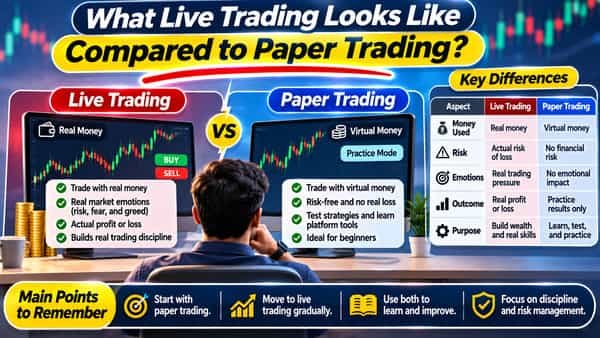
Paper trading uses virtual money to simulate buying and selling financial instruments. Traders can practise identifying opportunities, placing orders and monitoring positions without risking actual capital.
Live trading involves placing real orders through a brokerage account. When an order executes, it creates an actual financial position, with real profits, losses and transaction costs.
The Order That Changes Everything
Imagine a trader identifying a potential buying opportunity in a stock.
In paper trading, the trader enters a simulated order. Depending on the platform, it may execute immediately at the displayed market price. The account balance changes virtually, and the trader can evaluate the decision without financial consequences.
Live trading introduces additional variables.
An order must reach the market, find available liquidity and execute according to the selected order type. The final execution price may differ from the price displayed when the order was placed.
This difference is called slippage.
During volatile trading sessions, prices can move rapidly. A market order may execute at an unexpected price, while a limit order may remain unfilled.
Paper trading platforms do not always reproduce these conditions accurately.
The Emotional Difference Is Often Larger Than Expected
A simulated loss is usually easier to accept because it does not reduce actual savings.
Live trading can create emotional pressure even when the trader follows the same strategy.
Fear may encourage someone to exit a position prematurely. Excitement may lead to unnecessary trades after a profitable session. A losing position can also tempt traders to ignore their original risk limits.
These reactions are difficult to reproduce through simulation.
Paper trading can help develop familiarity with trading tools, but it cannot fully demonstrate how someone will respond to financial uncertainty.
Where Trading Costs Enter the Picture
Live trading involves expenses that may be absent or simplified in a simulator.
For Indian traders, relevant costs can include brokerage, Securities Transaction Tax where applicable, exchange transaction charges, GST on applicable charges, stamp duty and other regulatory fees.
The exact costs depend on the instrument, transaction and brokerage arrangement.
Even when individual charges appear small, frequent trading can significantly affect overall results.
A strategy that produces a modest simulated profit may become unprofitable after realistic transaction costs and execution differences are considered.
Paper Trading vs Live Trading: Key Differences
| Feature | Paper trading | Live trading |
|---|---|---|
| Capital | Virtual funds | Actual money |
| Financial loss | Simulated | Real |
| Order execution | Platform simulation | Actual market conditions |
| Slippage | May be simplified | Can affect execution |
| Transaction costs | Often estimated | Actual applicable charges |
| Emotional pressure | Usually lower | Often higher |
| Main purpose | Practice and evaluation | Real market participation |
What Paper Trading Can Teach Effectively
Paper trading remains valuable when used with realistic expectations.
It allows beginners to understand order types, become familiar with charts and observe how different market conditions affect a trading approach.
It can also help traders maintain records of their decisions.
A useful trading journal records the reason for entering a position, the intended exit conditions and whether the original plan was followed.
However, virtual account results should not be treated as reliable predictions of future performance.
A strategy tested during favourable market conditions may behave differently during sudden volatility or prolonged market declines.
Why Simulated Profits Can Be Misleading
Paper trading sometimes encourages unrealistic behaviour.
A trader may use an unusually large virtual account, enter positions without considering liquidity or ignore losses because no actual money is involved.
Some platforms also provide simplified fills that would be difficult to achieve consistently in real markets.
Consequently, a high simulated return does not establish that a strategy is profitable under actual trading conditions.
More meaningful evaluation considers consistency, drawdowns, execution assumptions and the number of observations rather than focusing only on total profit.
Frequently Asked Questions
Q1. Is paper trading the same as demo trading?
A. Generally, yes. Both terms describe simulated trading using virtual funds, although platform features and market-data arrangements may differ.
Q2. Can paper trading prepare someone for live trading?
A. It can help develop technical familiarity and decision-making discipline. However, it cannot fully reproduce actual execution conditions, financial consequences or emotional pressure.
Q3. Why do traders sometimes perform better on paper?
A. Simulated trading may involve easier order execution, fewer realistic costs and less emotional pressure. These differences can make results appear stronger than they would be in live markets.
Q4. Does live trading guarantee accurate execution at the displayed price?
A. No. Actual execution depends on liquidity, volatility, order type and available market prices. Orders may execute at different prices or remain unfilled.
Q5. Can paper trading result in real financial losses?
A. A genuine paper trading account uses virtual funds, so simulated trading losses do not directly reduce real capital. However, paid platform subscriptions or market-data services may involve actual expenses.
 Meghna Sharma