 By Saurav Mehra
Finding a photograph online does not make it free to use. A picture taken from Instagram, Facebook, Google Images or somebody’s WhatsApp profile may be easy to download, but using that photograph on a website, advertisement, poster or social-media campaign can involve more than one person’s legal rights.
In India, using someone’s photograph without permission is not automatically illegal in every situation, but neither is there a general right to use another person’s image however you want. Copyright in the photograph, the photographed person’s privacy, the context in which the image was taken, commercial exploitation, misleading endorsement and the manner of publication can all affect the legal position.
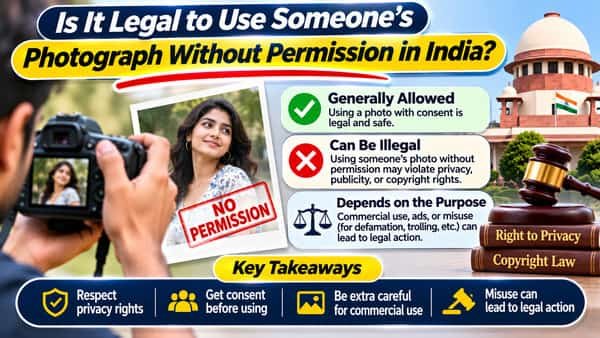
This is why permission may be unnecessary in one situation but extremely important in another.
Who Actually Owns a Photograph?
The first issue is often misunderstood: the person appearing in a photograph does not necessarily own the copyright in that photograph.
Under the Copyright Act, 1957, a photograph is protected as an artistic work. The photographer is generally the author, although ownership can depend on circumstances such as employment, commissioning arrangements and contractual terms.
Consider a photographer who takes a portrait of a model. The model is the subject of the photograph, while copyright ownership is a separate legal question.
Therefore, if you copy a photograph from another website, you may potentially need to consider both:
- Rights associated with the photograph itself; and
- Rights and interests of the identifiable person depicted in it.
Obtaining permission from the person shown in the image does not necessarily give you the photographer’s copyright.
Can You Use a Photo Found on Google Images?
You should not assume so.
Google Images is primarily a way of discovering images available on websites. It does not mean that every image displayed in search results is copyright-free.
If you download another photographer’s image and reproduce it on your commercial website without a licence, the copyright owner may potentially object.
The Copyright Act gives copyright owners exclusive rights over specified uses of protected works. Unauthorised exercise of those rights can amount to infringement unless a statutory exception or other lawful basis applies.
There are exceptions under Section 52 of the Copyright Act, including certain forms of fair dealing for purposes such as private or personal use, criticism or review, and reporting current events. But these exceptions should not be interpreted as a general licence to copy photographs from the internet.
Does the Person in the Photo Have Privacy Rights?
Yes, privacy can be a separate issue from copyright.
The Supreme Court has recognised privacy as a fundamental right under Article 21 of the Constitution. Privacy includes important aspects of personal autonomy and control over personal information.
However, privacy is contextual.
A photograph showing someone incidentally walking through a crowded tourist destination presents a different situation from secretly photographing the same person in circumstances where they reasonably expect privacy.
This distinction becomes particularly important with intimate photographs.
Section 66E of the Information Technology Act, 2000 specifically punishes intentional or knowing capture, publication or transmission of an image of a person’s private area without consent in circumstances violating that person’s privacy.
The provision can apply regardless of whether the person was technically in a public or private place where the statutory requirements are satisfied.
What If the Photograph Was Taken in Public?
Being photographed in a public place does not automatically give everyone an unrestricted right to use that photograph for every imaginable purpose.
For example, suppose a photographer captures a large crowd at India Gate and an individual happens to appear in the background. That is substantially different from taking a close-up of that individual and later using the image in an advertisement implying that the person recommends a particular product.
The legal issue therefore extends beyond where the photograph was taken.
You should also consider:
- Why it was taken;
- Whether the person was specifically targeted;
- How the photograph will be used;
- Whether the use is commercial;
- Whether it implies endorsement;
- Whether the accompanying statement is false; and
- Whether the image reveals something private or sensitive.
Context determines risk.
Can a Business Use a Customer’s Photograph in an Advertisement?
Businesses should be particularly careful.
Imagine that a customer visits a gym. The gym takes a photograph during an event and later places the customer’s face in a Facebook advertisement stating, “Thousands have transformed their bodies with us.”
Even if the photograph itself was originally taken lawfully, using an identifiable person’s image for advertising without appropriate permission can create separate issues.
For promotional campaigns, brands should generally obtain clear consent or an appropriate model release covering the intended use.
The same caution applies to:
- Website testimonials;
- Clinic before-and-after photographs;
- Coaching advertisements;
- Real-estate promotions;
- Social-media advertisements;
- Product endorsements; and
- Influencer campaigns.
Commercial use is much more sensitive than someone simply appearing incidentally in a general photograph.
What About Celebrity Photographs?
A celebrity’s photograph is not automatically free for businesses to exploit.
Indian courts have dealt with claims involving personality or publicity rights, particularly where a celebrity’s name, likeness, voice, image or other identifiable attributes are commercially exploited or used in ways suggesting endorsement.
However, personality rights should not be oversimplified into a rule that nobody may ever publish a celebrity’s photograph without permission.
News reporting, commentary, artistic expression, public-interest use and commercial endorsement can involve different legal considerations.
For example, using a photograph of a cricketer in a genuine news report about a match is materially different from placing the same cricketer’s image on a product advertisement in a manner suggesting that the cricketer endorses it.
Can You Use Someone’s Instagram or Facebook Photo?
Public visibility is not the same as permission for unrestricted reuse.
If someone uploads a photograph publicly to Instagram, it may be visible to thousands of people. That does not necessarily transfer the copyright to every viewer or authorise every business to download it and use it in advertisements.
Similarly, the fact that a photograph can be downloaded or screenshotted does not determine whether it can legally be republished.
Before using a social-media photograph, identify:
- Who owns the copyright?
- Whether you have a licence to reproduce it.
- Whether the person depicted has consented to the proposed use where consent is appropriate.
Can Someone Use Your Photograph to Defame You?
The photograph itself may be genuine while the way it is presented is misleading.
Suppose someone publishes an ordinary photograph of a person alongside a false statement accusing that person of fraud or criminal activity.
The dispute is no longer simply about permission to use a photograph. Depending on the facts, India’s defamation laws and other remedies may become relevant.
Editing a person’s image to create a false impression can similarly increase legal risk.
AI-generated or manipulated images can make this problem even more serious where they falsely depict a real person doing something they never did.
What About Intimate or Private Photographs?
Consent must be treated especially seriously with intimate imagery.
If someone privately sends a photograph to a partner, that does not mean they have consented to the photograph being forwarded to friends, uploaded online or otherwise distributed.
Section 66E of the IT Act specifically addresses certain privacy-violating images of private areas. Other criminal and cyber-law provisions can also become relevant depending on whether material is obscene, sexually explicit, depicts a woman in a private act, involves harassment, or concerns a child.
Never assume that consent to take or receive a photograph equals consent to publish it.
These are separate questions.
When Can a Photograph Be Used Without Permission?
There are circumstances where use without obtaining fresh permission from the subject may be lawful—for example, depending on the facts and rights involved, legitimate news reporting, certain fair-dealing uses, court proceedings, law-enforcement purposes, or situations involving appropriately licensed images.
The key question is not simply:
“Did the person give permission?”
A proper legal assessment asks:
Who owns the photograph, what rights apply, what is the purpose of the use, what privacy expectation exists, and does a statutory exception or licence permit the use?
For businesses, advertisers and website owners, obtaining appropriately documented permission is often the safest approach when an identifiable person’s image will be central to commercial promotion.
FAQs
Q1. Can I use someone’s Facebook profile picture on my website?
A. Do not assume that a publicly visible profile photograph is free to reuse. Copyright may belong to the photographer or another rights holder, while commercial or misleading use of the person’s identity can create additional legal issues.
Q2. Can a company use my photograph in an advertisement without asking me?
A. Commercial use of an identifiable person’s image without appropriate permission can create legal risk, particularly where it falsely suggests endorsement or exploits the person’s identity. Businesses should generally obtain appropriate consent/model releases for promotional use.
Q3. If I took the photograph myself, can I use it anywhere?
A. Owning copyright in a photograph does not necessarily eliminate privacy, personality, confidentiality or other rights of the person depicted. The circumstances and proposed use still matter.
Q4. Can I use a celebrity’s photograph in a blog article?
A. A genuine editorial or news use is legally different from using the celebrity’s photograph to imply commercial endorsement. Copyright in the photograph must also be considered separately from any personality/publicity-right issues concerning the celebrity.